
After watching ENTOURAGE: Murder Amongst Friends (2025), I found myself grappling not with the question of whether I liked the work, but with how best to approach it as a relatively young audience who is unfamiliar with Jit Murad’s creative context. For those well-versed in Jit’s oeuvre, or who carry vivid memories of Kuala Lumpur’s decadent urban atmosphere in the 1990s, this play naturally occupies multiple coordinates, such as “first draft,” “posthumous work,” “slice of an era,” and “inside joke.” Their lived experience fills in many of the contextual gaps in the play. However, for new audiences, such contextual “completion” cannot be a prerequisite for the entry. It is for this reason that I must begin this review by candidly acknowledging my own position as an outsider — geographically, generationally, and ethnically — admitting the limits of my understanding and seeking to identify the structural disconnections between the work and its audience.
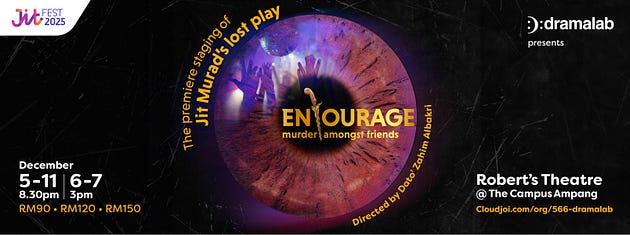
This production, presented by Dramalab as the last highlight of JitFest 2025, is promoted as the premiere of a “lost” Jit Murad play. Written in 2000 but never completed and performed, the script remained in draft form until it was unearthed three years after Jit’s passing and finally staged at Robert’s Theatre (The Campus) in Ampang, under the direction of Zahim Albakri and with Ida Nerina as producer.
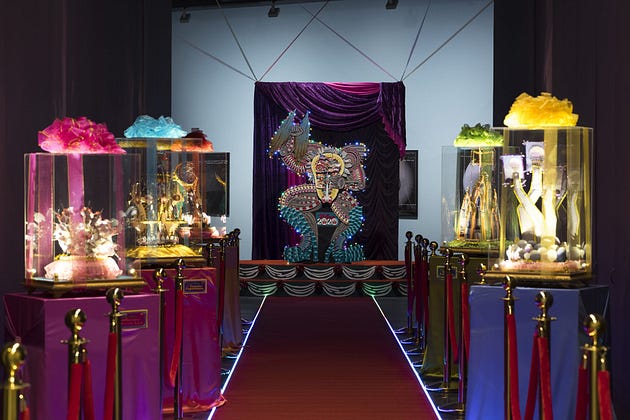
Notably, the production’s publicity leans heavily into the “whodunit” genre, complete with the insider tagline “Once you’re in, you’re in.” Simultaneously, official discourse frames the play as a commemorative event, emphasizing that this “rediscovered play” offers audiences a rare glimpse into Jit Murad’s imagination and narrative craft. The experience is further ritualized by an exhibition space dedicated to Jit’s works and life, which audiences pass through before entering the theater, priming them to approach the performance with a sense of reverence.
As a result, post-show discussions rarely revolve around the question of “who did it,” as one might expect from a conventional mystery. Instead, the focus shifts to the kind of viewing posture the production expects from its audience. Is the mystery truly the main course, or is the murder potentially a gateway to a broader social diagnosis — one that interrogates friendship, class, cultural capital, and identity? Rather than fixating on whether the play “counts” as a suspense drama, it is more worthwhile to examine:
When a work borrows the shell of a suspense genre, what kind of narrative contract does the audience implicitly accept the moment they enter?
In the best character-driven mysteries, characters are never mere accessories to the protagonist or vehicles for the playwright’s self-expression. Instead, every line is woven into a relentless “clue economy,” serving simultaneously to protect, mislead, or reveal. Consider how The Mousetrap maintains tension through idle chatter in a confined space, transforming ordinary people into suspects and compelling the audience to scrutinize every self-narrative. Or how Murder on the Orient Express distills deduction into a contest of testimonies and positions, with Poirot probing not only physical evidence but also the emotional responses to clues, ultimately confronting the audience with a moral dilemma about justice.
In such works, character constructions must immediately translate into cognitive advancement. After each scene, the audience’s assessment of credibility, suspicion, and hidden motives should be forced to evolve. Without this, suspense becomes little more than a label.
This is precisely where ENTOURAGE falters. As nearly two hours before intermission are devoted to repetitive scene-setting and the “entourage” display, yet character actions rarely generate the differentiation essential to a deductive structure. The truth, which should be gradually revealed through flashbacks, arrives late, and is instead crowded out by character sketches that do little to propel the plot forward.
The true value of ENTOURAGE lies not in whether it is “tight” or “mind-bending,” but in its potential as a vivid slice of life of Kuala Lumpur’s urban Malay elite youth in the 1990s. Seen from the vantage point of a more conservative and polarized Malaysia in 2025, the play’s psychedelic, swinging, upper-middle-class self-performance becomes a rare window into a national Malay subjectivity that would soon be overshadowed by more religious dominant narrative — once confident yet hollow, cosmopolitan yet anxious about identity, fluent in the language of cultural capital yet unsure who they were speaking for.
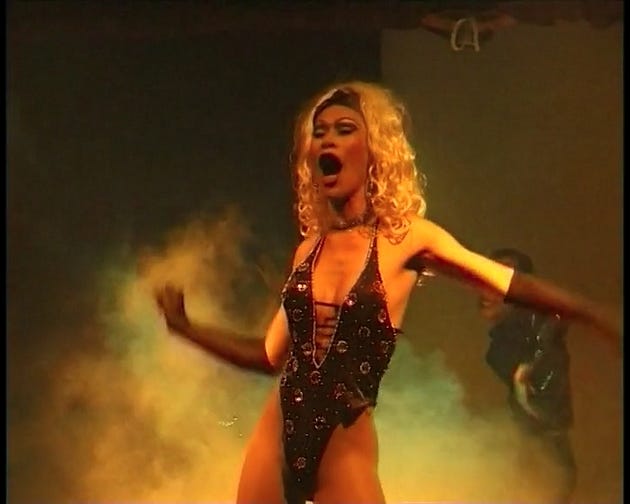
This urban Malay subjectivity did not arise out of nowhere. The 1990s in Kuala Lumpur were marked by a crossroads of modernization and social upheaval: Mahathir’s Vision 2020 spurred rapid economic growth and urban expansion, with megaprojects like the Petronas Twin Towers symbolizing national confidence and Asian Tiger ambition. Yet the 1997 Asian Financial Crisis abruptly ended the boom, followed by the Anwar incident and Reformasi movement, igniting political crisis and social division. Urban Malay elite youth were left suspended between prosperity and crisis, national narratives and identity anxiety, resulting in a profound sense of confusion and alienation. Under the high-pressure myth of modernization, a countercultural energy emerged — parody, mockery, crossover, and DIY became tools of resistance. As documented in ILHAM Gallery’s “Boom Boom Bang: Play & Parody in 1990s KL,” creative circles like Five Arts Centre, Instant Café Theatre, and punk band Carburetor Dung became frontlines for identity negotiation and social critique. As the beneficiaries of the New Economic Policy, English education, and globalized living, this generation enjoyed urban consumer freedom while keeping their distance from traditional Malay values and official nationalism. Labeled “Melayu celup” (Malay on the outside, Westernized within), they searched for themselves in diverse arts, music, nightlife, and cross-ethnic interactions, yet wavered between national identity and modernity.
This contradiction — confident yet hollow, cosmopolitan yet insecure — is the spiritual undertone of Jit Murad’s characters.
Yet, this countercultural movement was also a form of escape. For many urban elite youth, art, parties, fashion, and humor were both resistance to reality and a buffer against crisis. ENTOURAGE becomes a microcosm of this era: a party in a bohemian KL suburb house, where artists, designers, socialites, outsiders, and misfits seek identity through drugs, music, desire, wit, and self-mockery, only to be forced to confront the truth by a sudden murder.
Once this historical context is established, the play’s true potential lies in its ability to probe deeper: Why must these characters perform freedom with such intensity? How does this supposed openness quietly morph into cycles of class and cultural capital, even repackaging numbness to reality as taste and wit?
In several of Ghani’s dialogues and confrontations, we see him wield Western theoretical references as conversational power chips — using citation and posture to overshadow others’ experiences, oscillating between identity anxiety and cultural vanity, and even turning intimate relationships into stages for conceptual performances. These moments genuinely give voice to the “slice of an era” the play aspires to capture.
However, when the production uses the suspense genre as a marketing hook and “paying tribute to legacy” as its creative method, these materials often remain at the level of mere gesture and atmosphere, never coalescing into a narrative engine that advances and interrogates. What remains is a string of stylish but unfulfilled gestures. As the truth draws near, what the audience truly expects is for the plot to force these characters to expose the language strategies and relational structures that maintain their respectability, to translate anxiety into style, to turn moral issues into jokes, and to pay the price for each translation. Yet, all of this is ultimately drowned out by the endless house music, with the characters’ anxieties and contradictions diluted into mere posturing, never accumulating into effective narrative propulsion.

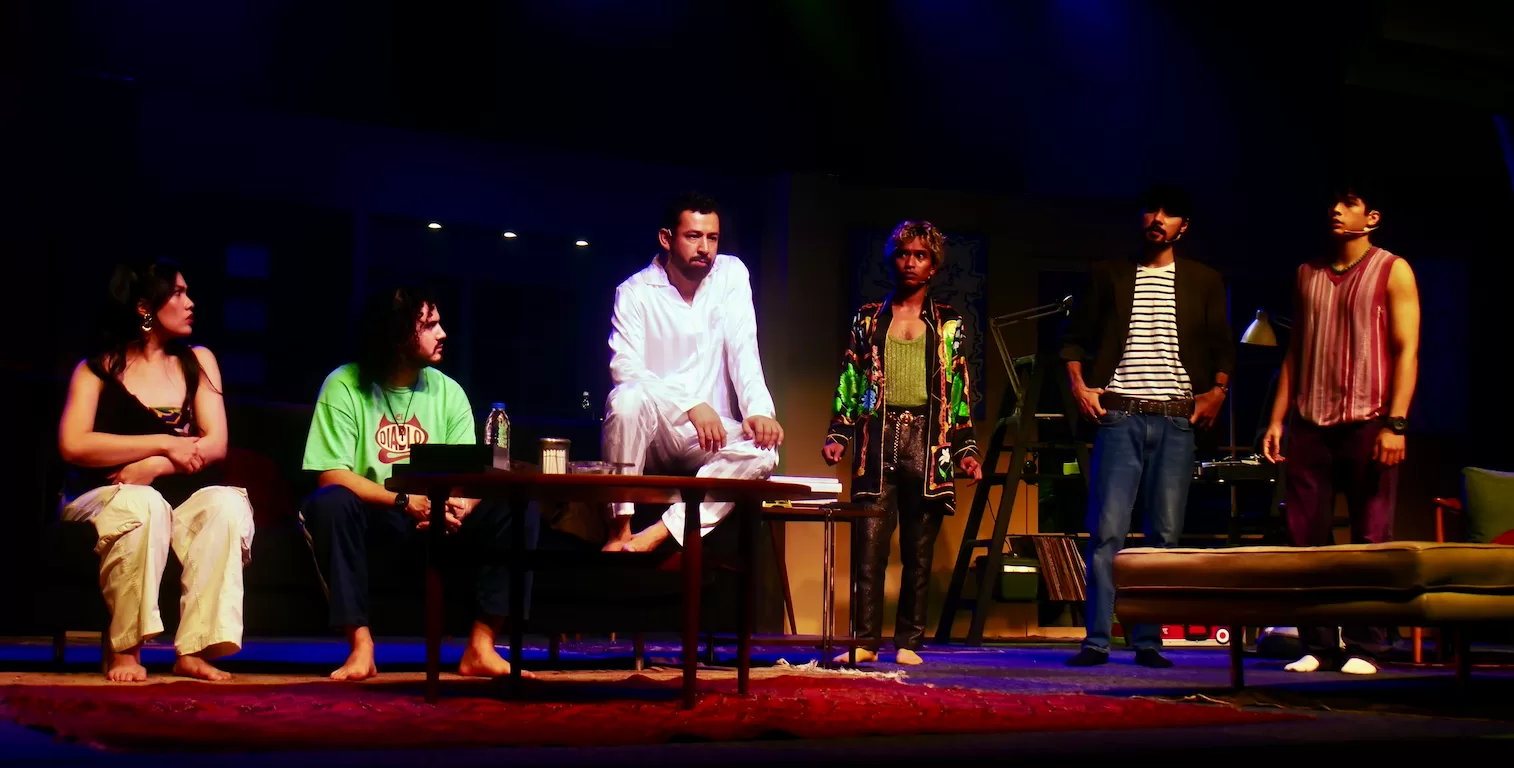
It must be acknowledged that the performance is far from chaotic. On the contrary, the overall command and energy exchange among the cast is quite impressive, particularly Ghafir Akbar as Ghani, who consistently transforms stiff, upper-middle-class lines into “necessary words” that keep the audience engaged even through lengthy passages. But to be honest, in the talent-rich Klang Valley scene, this level of professionalism is hardly rare. While the review on Bakchormeeboy[1] rightly praises the performances, but the more pressing question is whether such maturity sharpens the text or merely covers its flaws.
When actors deliver lines smoothly, with beautiful phrasing and practiced rhythm, is that really enough for an audience seeking suspense?
The dynamic between Wan and Ghani exposes this paradox. Wan (Nabil Zakaria), who clearly possesses the potential of a Shakespearean fool — whose laughter could have become a mechanism for unmasking, for deconstructing how “freedom” is packaged as style by class and cultural capital — yet, is here relegated to the role of sidekick, serving atmosphere and clue delivery. His exposure of Ghani’s queerness and hypocrisy remains at the level of gossip, never probing the psychological structure of 1990s new middle-class Malay subjectivity. Sonia (Mae Elliessa) and Lala (Sabrina Hassan) are similar; their confrontations remain at the level of language, never written as choices or consequences that could alter the game, so conflict stays at the level of posture, never growing into the irreversible turns suspense narratives require. Ade (Mia Sara Shauki) feels shoehorned in as a moral anchor; her refusal and resistance do not trigger others’ actions, yet she bears the “reporting” reversal at the end, a late and thin patch of reality. Mafuz (Engku Armand) is the most structurally wasted: as an outsider and creator, he should have continually forced Ghani to confront his own emptiness and anxiety as a hollow artist, even letting the “violence of cultural capital” have concrete consequences on stage. Instead, he is reduced to a device for explaining the stolen keris — eyeing Ghani’s collection, using Boy’s temptation to extract the hiding place, admitting to theft but not murder — so his existence becomes a rationalization for the “keris theft” as a plausible motive. Why can’t this motive fall more cruelly on a core relationship, or force a more uncomfortable ethical dilemma, rather than stopping at a “possible motive for murder” hypothesis?

If we re-examine the first act, it becomes clear that the Rectum Room scene is not the most redundant. On the contrary, it leaves behind clues for the second half — changes in posture in public spaces, the reshuffling of relationships, or the possibility of actions being witnessed by others — all of which are more traceable than the earlier scenes set in Ghani’s house. What truly needs condensing and cutting is the prolonged character and situation setup in Ghani’s house. The director continually prioritizes atmosphere, especially the house music that runs through almost the entire first act. But does this emotional cue provide meaning beyond mere ambiance? It neither becomes the characters’ subjective auditory experience, nor transforms into a structural unit of rhythm, nor creates cognitive breaks at key moments. Instead, it flattens many scenes into the same emotional plane, making it difficult for the audience to discern whether something new is happening or if it’s just an extension of the same decadent posture. As a result, the repeated overlay of atmosphere prevents character development from accumulating into meaningful clues.
This reliance on atmosphere and technique extends into the handling of projected flashbacks in the second half. Once 2D video is placed on a 3D stage, the inherent certainty overwhelms the ambiguity and instability of the actors’ bodies, especially when used as a vehicle for flashbacks. The narrative shifts from “someone’s version” to “evidence from the scene.” Suspense is no longer about who is lying or misleading, but about whether the audience is willing to accept what the screen declares as fact. Unless the director deliberately treats the video as an unreliable device — creating cracks and suspicion through perspective, editing, and sound — it only flattens the most precious imaginative space of Rashomon, reducing the audience’s game with information gaps to “just watch the screen.” Admittedly, multi-screen and video composition is a trend, but the issue is not whether to use video, but what function it serves in the narrative. When video repeatedly replaces stage movement and dramatic action, one must ask: is it expanding the theater’s cognitive dimension, or merely exposing the writer and director’s technical inadequacy in the face of complex narrative?
Similarly, Ghani’s posthumous appearance as a “spirit/angel” could have been a structurally potent device, capable of disrupting information, creating unreliability, even reversing judgment on those present, forcing the audience to reassess Ghani’s responsibility, power, and vulnerability. But the stage ultimately chooses to let this presence serve only as comic relief, neither increasing certainty nor creating real confusion. If the dead are “present,” why don’t they reveal the truth, or at least refuse to do so in a more complex, self-aware way? What kind of existence is this, and what are its rules?

This imbalance is reflected in the overall pacing of the play. The first act drags, excruciatingly slow, while the second compresses an excess of Rashomon-style deduction and video flashbacks into a single hour. Characters like Fash and Ade, who depend on structural support, end up feeling abrupt and forced, as if they must compensate for narrative gaps with exaggerated intensity. Rather than witnessing characters naturally evolving under pressure, the audience sees actors straining to make their lines “seem believable.” Overwhelmed by a barrage of explanations, viewers eventually stop trying to digest information and simply accept each character’s logic wholesale.
When Mafuz exposes that everyone is “guilty,” the stage shows no hesitation or struggle toward justice. Instead, the group swiftly shifts positions: they neither call the police nor pursue Ghani’s death. In fear and calculation, they reach a tacit understanding, treating the mistake as a fait accompli. Calmly, they divide up Ghani’s possessions, fabricate alibis, and act as if nothing happened.
This sequence is strikingly honest, as the characters finally drop their performative facades and acted with cold efficiency collectively. For the first time, the stage direction aligns with the characters’ ethical choices, sharply reflecting the mindset of the urban middle class in the era of economic expansion:
a group accustomed to clearing the scene after a crisis, redistributing resources, and moving on,
in a society that prioritizes development and efficiency over confronting its own ills,
constructing a logic that postpones responsibility and sets aside justice as long as the system keeps running.
Ghani, as the self-inflated cultural subject of that era, dies without changing anyone’s position or forcing anyone to bear consequences, leaving only a group of survivors who better understand each other’s bottom lines and how to conspire in silence. Had the story ended with Ghani being taken away by two “angels,” leaving the group standing in an emptied space, wouldn’t that cold, awkward tableau have been more shocking? As we watch the 1990s unfold on stage, only to realize that, decades later, little has truly changed.
Unfortunately, the play does not end there. Instead, it piles on affairs, accidents, and police reports, forcing all the characters back into chains of explanation, as if only by spelling out every moral and causal link can the ending be considered responsible. This narrative excess betrays a lack of trust in the audience and weakens the already-formed image of the era, raising the question of whether Malaysian theater is unwilling to hand over silence and darkness to the audience.

Let me be clear, this review is not a denial of Jit Murad’s legacy. On the contrary, I recognize the remarkable craft present even in this first-draft script, and the fact that the production failed to spark much public discussion or box office success only deepens my desire for a sincere dialogue — both with the late playwright I never met and the creative team so familiar with his work.
As Jo Kukathas reminds us, adapting a line from Tea and Sympathy:
“So years from now when you talk about Jit — and you will — be kind.”
Jo offers this sentiment to all who will speak of Jit Murad in the future, to new audiences like myself, and perhaps to creative teams who may one day stage his works. Many unrealized possibilities and regrets still linger in the text, waiting to be seen. I hope that, one day, we can move beyond mere commemoration and tribute, for such a text deserves — and indeed demands — to be critically reinterpreted and revised, so that it may truly engage with the present.
May we all find, between criticism and reverence, the space for genuine conversation and understanding.
Further Reading
[1] ★★★★☆ Review: ENTOURAGE — Murder Amongst Friends by Dramalab

Leave a Reply